07 Oct 2022

Even your uneven skin tone

Whether it is after a fun beach holiday or long hours of commute to work under the harsh sun, we have all dealt with skin tanning. It is known to be one of the most stubborn skin issues and can have a detrimental impact on your skin’s health. Your face, arms, neck, and feet are the most exposed to sunlight and are more likely to get tanned quickly. A day out is always fun until you realize your hands and feet are two shades darker. Getting the right information about how the condition develops and its treatment options can give you an upper hand to deal with uneven skin tone.
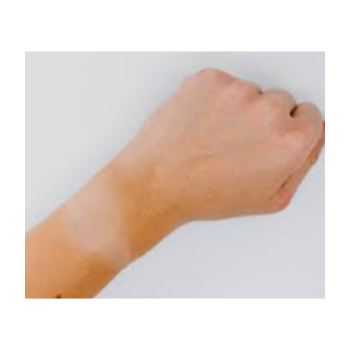
Tanning is described as skin darkening mostly due to sun exposure for prolonged periods of time.1 Ultraviolet (UV) radiation is emitted by the sun, which is of three types: UVA rays have the longest wavelengths, i.e., 320–400 nm, UVB rays form nearly 5% of the light spectrum with wavelengths ranging from 290–320 nm, and most of the UVC rays do not reach the earth as these are absorbed by the ozone layer. Exposure to UVA is responsible for free radical species development, aging, and wrinkling. UVB is the more intense form. Glance through the figure below to understand the differences between UVA and UVB radiations:

So, how does our skin fight this ruthless sun’s radiation?
The outermost layer of our skin, the epidermis, has a group of cells called melanocytes. Melanocytes produce melanin, which provides a shielding effect against radiation. It acts as a physical barrier that scatters UV radiation (UVR) and decreases the penetration of UV rays into the epidermis.3 Melanin content determines our skin color and the higher the melanin production, the darker the skin gets! Once tanned, it takes a couple of weeks or even months for the skin to get back to its base color.
Tanning accelerates skin aging and could leave the skin looking dull and lifeless. To prevent this, the belowmentioned tips can come in handy to rejuvenate your skin and bring back its glow:
Repair your skincare routine
Most of us follow the same regime every day, but as disappointing as it sounds, skincare is far from static. You might want to get your hands on a different day/night cream, face wash, and moisturizer to get the desired effects. Next time you step into a cosmetic store, be on the lookout for products containing the ingredients given here.
1. Kojic acid
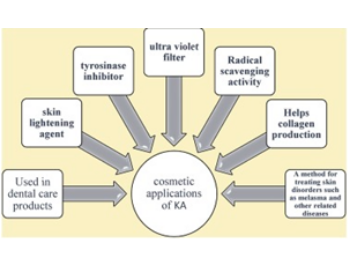
It is a product obtained from various natural sources like fungi and the fermentation of certain Asian foods like rice, wine, and soy sauce. Kojic acid and its derivatives block the pigment formation by melanocytes and are one of the most popular skin brightening agents in cosmetics. Other cosmetic applications of kojic acid are given in the figure:
2. Rumex occidentalis
It is a perennial herb in Asia and its extract is added to several skincare products. It blocks melanin formation and research shows that either alone or in combination with other compounds, it is an ideal depigmenting agent.6 In a study on 50 women in which the participants applied creams consisting of Rumex occidentalis along with another compound (nonapeptide-1) twice every day for 4 weeks resulted in several improvements as given below:

3. Arbutin
It is one of the most prescribed depigmenting and brightening agents all over the world. It is a plant-derived compound commonly found in dried leaves of plant species like pear, blueberry, and cranberry.
4. Tetrahydrocurcumin
It is a product derived from yellow curcuminoids and is proven to be an efficient antioxidant compound for skin brightening. It inhibits melanin synthesis and protects the skin by scavenging free radicals that are produced by UV radiation exposure, and aids to maintain general skin health. It is widely used in antiaging, sun care, and after-sun care formulations.
5. Mulberry and liquorice extract
Mulberry contains numerous valuable bioactive substances that are widely being explored in the cosmetics industry. Its extract helps to prevent skin issues and improves its overall appearance by inhibiting free radical oxidative activity. Liquorice is obtained from the Glycyrrhiza glabra Linnera root. The main component of liquorice extract is glabridin. It prevents UVB-induced pigmentation and even exhibits anti-inflammatory activity.
6. Artocarpus extract
Artocarpus extract has shown a reduction in melanin formation in studies, and it is known to produce a faster onset of a brightening effect. It has been commonly used as an anti-skin aging and whitening agent in cosmetic products. It also delivers water-soluble substances deep into the skin, thereby enhancing skin permeation.
Now that you are aware of what to look for in skincare products, adopt these simple practices to keep yourself from further sun damage:
• Apply sunscreen
Whether it is sunny or cloudy, apply smother generous amounts of a broad-spectrum sunscreen on your skin every day, at least 20 minutes before heading out. Make it a habit like you check your phone first thing in the morning. Also, don’t forget to use a lip balm with a sun protection factor (SPF) for maximum protection.
• Avoid midday sun
The sun is the strongest from 10 am to 4 pm. As much as possible, try to limit exposure to the sun during this period.
• Cover, cover, cover yourself up!
Go get a cap, scarf, or anything that offers good sun protection. If you are going to stay outdoors for extended periods, wear loose-fitting, full-sleeved clothing to minimize sun exposure. And well, put on some cool sunglasses too!
• Choose the shady side
When outdoors, keep in mind the shadow rule: “Watch your shadow - short shadow, seek shade!”
You know by now that overexposure to the sun is dangerous. Hopefully, you are all ready to invest in some amazing skincare products having natural ingredients, and to follow basic safe sun practices to get long-lasting results!
References
1. Stapleton JL, Hillhouse J, Levonyan-Radloff K, et al. Review of interventions to reduce ultraviolet tanning: Need for treatments targeting excessive tanning, an emerging addictive behavior. Psychol Addict Behav. 2017;31(8):962-78
2. Garone M, Howard J, Fabrikant J. A review of common tanning methods. J Clin Aesthet Dermatol. 2015;8(2):43-47.
3. Rachmin I, Ostrowski SM, Weng QY, et al. Topical treatment strategies to manipulate human skin pigmentation. Adv Drug Deliv. 2020; 153:65-71.
4. Brenner M, Hearing VJ. The protective role of melanin against UV damage in human skin. Photochem Photobiol. 2008;84(3):539-49.
5. Saeedi M, Eslamifar M, Khezri K. Kojic acid applications in cosmetic and pharmaceutical preparations. Biomed Pharmacother. 2019;110:582-93.
6. Mendoza CG, Singzon IA, Handog EB. A randomized, double-blind, placebo-controlled clinical trial on the efficacy and safety of 3% Rumex occidentalis cream versus 4% hydroquinone cream in the treatment of melasma among Filipinos. Int J Dermatol. 2014;53(11):1412-16
7. Fade unsightly skin pigmentation [Internet]. [cited 20 Jul 2022]. Available from: https://www.thefreelibrary.com/Fade+unsightly+skin+pigmentation.-a0496644972
8. Sarkar R, Arora P, Garg KV. Cosmeceuticals for hyperpigmentation: What is available? J Cutan Aesthet Surg. 2013;6(1):4-11.
9. Skin lightening effect of tetrahydrocurcumin [Internet] [cited 20 Jul 2022]. Available from: https://www.hilarispublisher.com/conference-abstracts-files/2376-0427-C1-009-003.pdf
10. Jan B, Parveen R, Zahiruddin S, et al. Nutritional constituents of mulberry and their potential applications in food and pharmaceuticals: A review. Saudi J Biol Sci. 2021;28(7):3909-921.
11. Tengamnuay P, Pengrungruangwong K, Pheansri I, et al. Artocarpus lakoocha heartwood extract as a novel cosmetic ingredient: evaluation of the in vitro anti-tyrosinase and in vivo skin whitening activities. Int J Cosmet Sci. 2006;28(4):269-76.
12. Hossain, MF, Islam A, Akhtar S, et al. Nutritional value and medicinal uses of monkey jack fruit (Artocarpus lakoocha). Int Res J Bio Sci. 5. 60-63.
13. Radiation: Sun protection [Internet]. [cited 20 Jul 2022]. Available from: https://www.who.int/news-room/questions-and-answers/item/radiation-sun-protection
Related blogs
Lorem ipsum dolor sit amet, consetetur sadipscing elitr, sed diam nonumy eirmod tempor invidunt ut labore et dolore magna...